(This post I started quite some time ago but I'll add it here for continuity's sake)
It is almost 1am and I'm wide awake, sitting in the kitchen of my mud hut by the light of my gas lamp, wondering, "Alla mene bi?" -- Are the rains coming? Although the human sense of weather forecasting is becoming more and more acute for me here, I'm not yet as versed as the Malians. Tonight I ate toh in the pitch dark with the Kansayi family (my homologue), and we all remarked how heavy with dampness the air was. Only hours later do I realize that this was an indication of the storm to come. I fell asleep outside under my mosquito-net covered mattress, reading a book called Blindness by Jose Saramago, thinking about what it must be like to live without the precious gift of sight. But then just an hour ago I awoke because of some almost imperceptible change in the air-- my body sensed that something was happening, although the air was still and the temperature unchanged. I opened my eyes to see faint flashes of lightning in the distance-- something that should be imperceptible in slumber, but that nonetheless I was somehow keenly aware of. Sure enough, thirty minutes later the wind picked up, the sky let out a whisper and then a beckoning thunder. Le temps menace, as they would say.
Such a gift of rain would surely ease the troubled and lost mind of the village vielle -- an old woman of 80 or 90 (or so the villagers say) who has been posted up outside my concession under a neem tree every day since my arrival, asking when the rains will come. The first time I came to Pelleni everyone blessed my arrival, for the rain came swift and strong that evening- a sign of good luck and much promise from a stranger. Perhaps this is why the vielle was so dismayed at my second visit's failure to produce such positive results. In response, she called to me from outside my gate, asking for alms as an alternative to the rain, her eyes clouded by cataracts (can she see the rain coming?), skin and flesh hanging leathery off her old bones like half-dried venison. The hot sun will dry her up all the way soon enough, I imagine (Is this why she laments the absence of rain?).
Surely, I too will be sad to see the rainy season go-- to watch the green turn to brown and the rivers and creeks trickle away until they become sandy beds. But now I look forward to the coming of the cold and dry season, because of all the practical annoyances of the humidity and rain. Every time the rain comes like this at night, it means a forced and abrupt end to my much-needed slumber: I have to hop up and untie my mosquito net and drag it and my mattress, mat, sheets, pillow, chair and lantern back inside the sauna that is my house. I re-set up this scene indoors, and then have to check that all of my valuables are covered by a sheet of plastic or properly stowed, so as not to be splattered by the chunks of mud that invariably come weeping out of my poorly built cieling with every hard rain. I'm also concerned about the presence of heat and humidity inside this stuffy house, because various forms of white mold have sprouted up on the rafter beams, spreading white fingers weaving through the support branches and down the mud walls. (Another reason I prefer to sleep outdoors rather than inhale these spores...) But, it is pleasant to sit here and write by the light of the lantern, the sound of the rain tapping on my metal window panes.
I'm going to feel a lot here.
September 23, 2009


September 22, 2009
When Life Gives you Lemons...
As I left the Sevare Peace Corps bureau for site, a PCV from the stage above me left me with this parting consolation-- "If you cry your first night at site, don't worry. I did too." My initial reaction to this was surprise, then confusion, and finally appreciation. I was lucky enough to not be anywhere near this kind of mindset when I headed down the road for Pelleni-- I was thrilled. But her comment made me realize that we are all handling this experience with differing degrees of grace and panic and confusion and elation. A day later I found myself close to tears at site, but not out of sadness or fear. Rather, I found myself almost moved to cry because of a realization I had when sitting at one of the boutiques in town. I was watching a new friend, Khadija, breast feed her baby girl, and I realized all of the sudden that I would be able to see this child grow up so much in the next two years. I looked around at everyone in this scene that only a month ago seemed like it would always be foreign-- girls tressing each other's hair on plastic mats covering the trash-laden ground, men inhaling smoke from their pipes and cigarretes while taking in the new stock for the boutique, mothers clucking the town gossip to each other, their children tugging at their worn breasts for milk, flies swarming incessantly around bits of fallen meat or the open cuts on children's arms and legs, the constant thump of mortar and pestle from women grinding millet nearby. I realized for the first time that these will be my friends for the next two years, and hopefully for life. I finally took it all in, and exhaled happily...
___ ________ _________ ___________ _________
It continually blows my mind that I learned skills at home that are useful here in such a drastically different context. How to fix, start, and clean a gas lantern, for example. This is a simple but familiar skill I acquired that came in handy immediately at site, in the moonless darkness that only a Sahelian African village knows. This task I became practiced in after doing a hundred times in the most unlikely of places-- Burning Man.
Flashback to a dust storm in the middle of the desert, Black Rock City, Nevada... Dozens of half-naked and day-glo painted bodies, clad in bikini bottoms, face masks and swirling goggles, crouched over tables in an almost futile attempt to light hundreds of gas lamps for the ritual nightly Lamp Lighter's procession... all this in the dust and rain and wind before night fall, to the point that blisters formed on our fingers from switch after switch of the metal wheel of a lighter.
We always joked we were training for the apocalypse-- who knew I was really preparing myself for Africa?
Another example comes to mind: Making cordage and rope from discarded plastic bags. When I first did this at my happy hippy permaculture community home of Aprovecho in Oregon, it seemed like such the simple yet conscious, ingenuitive thing to do. Today I watched grown men engaged in the same activity at site, doing so not to be good environmentalists, but rather as a survival technique. They take what they get and do damn hard to make something out of it.
Which brings me to an interesting phrase we use in the U.S.-- "When life gives you lemons, make lemonade." We talk a lot in Peace Corps Mali about a concept related to this-- they dub it the 'value chain.' This is basically just the Econ 101 idea of value-added goods: you take a raw good, introduce some production process, and thereby develop a new finished product that will yield a higher profit. Every sector here is taught to promote this idea. But this lemony phrase-- this seemingly apt, simple and obvious statement, when reflected upon, reveals itself as entirely culturally relative. Even though it is about optivism, it is couched in economic presuppositions that don't necessarily exist everywhere. The cynical side of me wants to ask this burning question: What if life doesn't just simply give you lemons? What if you have to grow the lemons yourself? What if, in one scenario, you and your family have to spend every day planting and taking care of these lemon trees, because they're virtually the only thing that can grow in your region? What if you survive off of eating lemons, but to process them into a meal takes an entire day's work? Or in another scenario, if you're lucky enough to have more lemons to spare than just for your own subsistence, what if you spend all of your time and money to produce lemonade for retail (buying sugar, hauling water from a well, buying bags/bottles and extra ingredients, paying for the electricity and the usage of a fridge to cool it)? What if after all this, no one around you can afford to buy it except at a price that leaves your profit margin hanging on dimes and cents? These two scenarios parallel common income/food generating activities here-- harvesting millet to make toh for subsistence farmers in the North of Mali, and producing the hibiscus plant used all over West Africa to make a sweet crimson juice called dablini (or bissap).
I suppose this is why I'm not a Small Enterprise Development sector volunteer. Hopefully these "what if's" will find their answers for me in the next two years. For now, I am simply reminded of a line from a song school children in the south of Senegal sang to me once. It translates to this: "We, the cultivators, despite our misery, have never known despair."
September 16, 2009
Aw bisimillah to the new "Risky Business"
Two weeks slip by so fast, and yet it feels like ages since I last updated my blog. So much has happened. Last week I officially swore in as a Peace Corps volunteer, thus completing my two months of training. The last week at homestay was a blur, and then came a week of celebration, goodbyes and new hello's. The last night at the training center at Tubaniso, we had an amazing talent show put on by the wonderful Owen (a true rennaissance man). We had almost ten different acts, and it was HILARIOUS. On my own part, I bunched together with several friends to perform a circus act, complete with juggling, hula hooping and chain smoking cigarettes. For those of you who know me well, you know I have no hula hooping skills-- but thanks to the lovely Katheryn Stofer I learned some mad skills in the 24 hours prior to the show. It was so much fun. The winning acts were a harmony of "the rains in Africa," a makeshift mad Malian dance by one of the shier (and unpredictable) volunteers, and a percussion set complete with vocals chanting "Tubaaaaaaaab, wake up!" in the style of the call to prayer heard every morning (and a re-enactment of the PCVs regular morning run to the nyegen). What a night. We put together a list of superlatives for all of the group, and they were unveiled throughout the show. Mine, quite fittingly I suppose, was "Most likely to teach her entire village to say 'yeah, man'". Man, I need to work on that. What a night.
On 9/9/2009 (a date to remember), I signed my contract as a Peace Corps volunteer, and two days later (9/11), we were all shuttled to the U.S. Embassy in Bamako to be given the benedictions of the Embassador and numerous other folks who I'm sure will have nothing to do with the next two years of my life. We rolled up to the Embassy at 9am, all dressed up in Malian garb and half hung-over from the celebrations the evening prior. The embassy stands in stark contrast to the rest of Bamako-- a pompous marble behemouth of a building with antennaes and satellite dishes dangling off it's ears like Akon's blinged out studs (I'm sure that won't be the first Akon reference, they LOVE him out here), and set amongst the only imported grass existing in that quantity in Mali. We sat down to listen to a dozen speeches all beginning with "Mesdames et Messieurs, son Excellence l'Embassadeur, etc.". I had the (un?)fortunate opportunity to be amongst the speech-givers, and got up in front of the 300-some crowd to give a speech in a language that only one (ok, two) understood a word of. It was aired nationally on Malian television, so it was an honor. I must admit, it was a beautiful and pride-instilling thing to watch my colleagues get up one by one and speak (damn well) in six different languages that none of us knew a word of only two months ago. They say that Peace Corps language immersion is the best way to learn a language, and I'd have to agree. Kanda, mii Dogulodomu dage dage damu belebun (now I can speak a fair amount of Dogulosso).
After the Embassy, we were whisked away to the American Club to begin our "Spring Break Mali 2009" celebration. Despite the fact that we were in the position to party like crazy in celebration, a looming fog seemed to hang over many of our heads about the next two years to come, and what that means for us emotionally. Nonetheless, we played in the pool, ate amazing food and watched Kill Bill in an air conditioned mini-theater-- a little bit of home before we got shipped off to the real Mali. Afterwards we were shuttled to the Campagnard, a hotel in downtown Bamako not far from the clubs, etc. I ate two ice cream cones and drank whiskey cokes, and got ready for a rowdy night. Since this whole experience has been akin to a 'new student orientation' at college, or even a summer camp, this was our last big bang, and as such some level of debauchery was required. We went to two different clubs and all danced like mad (which gets pretty sticky considering how damn hot it gets here). Each new class of entering PCVs ("stage" in French) is given a name at this point, and we were bestowed with the name "Risky Business". They thought about "the Mullets", since we're business in the front and party in the back... both get the same idea across. It's going to be a good two years with these folks.
Two days later we had to pack up our things for one final journey, and say our bittersweet farewells. Us, the Mopti Kaw, had yet another hazardous and haranguing experience making the trip up north, which took fifteen hours this time around. We'd better get used to this. A few days in Sevare, collecting everything from mattress pads to tea sets, chickens, cats and kola nuts, and we were ready to be shipped off to site. I sit here writing this post at the Hotel la Falaise (Hotel of the Cliffs) in Bandiagara, the night before I head out to Pelleni, my new home. The next three months will be a huge change of pace, but one that is much needed. This will be the time in which we make it or break it back to the States, and I wish the best of luck and peace to my friends spread out across the country, strugging to find their place in a world that is so different from our home.
August 25, 2009
Pelleni, home sweet home
So that last post wasn’t the end of my journey to site… it’s just the part that all of us shared as a group. Once I got to Sevaré I, along with 7 other Dogon PCTs, had to take another car for an hour into Bandiagara, which is our banking town. Sevaré is our ‘regional capital,’ so this is where I will go in the case of an emergency, if I ever get sick and need a place to crash, when I have grant writing or other computer-necessitating projects, or (definitely more likely and more frequently) to party with all of my fellow volunteers… which we’ve already begun. Mopti Caw seem to be notorious for getting a little rowdy, so I guess they placed me well. Currently two of the volunteers in this area are under threat of being administratively separated for riding motorcycles (not allowed) and/or public drunkenness (also technically not allowed, but it seems like this one isn’t enforced except under the most extreme situations). Bandiagara is going to be rowdy as well—this is one of the most touristy sites in Mali because of the draw of Dogon country, all of the hiking, etc. As such, there are a few really nice and reasonably priced hotels (one with a swimming pool!) and restaurants, as well as a couple of internet cafés. I imagine this will be my oasis when I’m starting to go crazy from being en brousse all of the time.
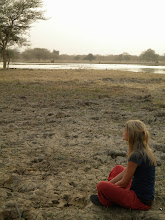
I spent a night in Bandiagara at a nice hotel with the other volunteers, and the next day they let us all loose to go to our individual sites! We were each paired up with our counterparts and our “site buddies” – current volunteers who live/work in the region, who came to site for a day or two with us to show us the ropes. I met my counterpart, Hassim Kansayi, who is a gardener in Pelleni, a few days prior for training. He is wonderful and enthusiastic and funny as hell. I went with him and a girl named Ashley, a PCV who lives nearby in a town called Kalibombo (villages have the best names here) with her husband Joe. We crammed into a bush taxi bus with about 20 other people, and with multiple rice sacks, buckets, bags and goats on the roof. These buses (really just gutted out vans) are so janky, they’re basically nothing but the bare minimum. Shocks/brake pads worn down, no power steering, no upholstery, body beat up. Everyone was staring at me, wondering what the hell a Tubab was doing going out into the bush. They’re used to tourists out there, but not ones who get off the beaten path. As such, volunteers are a bit of a novelty and generally people are really interested to know what we’re doing—they’re very welcoming. The ride was beautiful. The road on the 40 km route to my town, Pelleni, is mostly unpaved. But part of it was constructed with flat stones, which gives it a kind of old Europe feel. The area I’m living in is a series of rolling hills and valleys. The climate is definitely semi-arid, it feels to me like a mix of Arizona savannah and Moab, Utah. There are rocks everywhere, and virtually no topsoil, which makes for a beautiful landscape and incredible stone architecture, albeit sometimes impossible gardening. After about an hour in the bus, we got dropped off in what looked like the middle of nowhere… oh wait, it is the middle of nowhere. There isn’t a road that goes directly to my site, so I have to walk 3 km from the road to get to my village of 450 people. Since it’s the rainy season, I had to forge through a river on the way, dangling my bags around my neck and back, trying to pull my skirt up out of the water. The town is pretty (although admittedly not as pretty as I expected), nestled beneath a set of low rocky hills in a valley, surrounded (right now) by millet fields and tall towering trees. All of the fences are built of stone, and the huts are made of mud.
My house is great for the most part. I have my own concession, blocked off by a bamboo-looking gate and stone wall, with a space large enough to have a small garden and a chicken coop, and a cat to catch the mice (plans brewing already). There is a brouse ladder (a log with notches etched in it for steps) leading to the roof, where I will probably spend most nights staring at the immense sky—so many stars out there!—and sleeping in whatever breeze there is. I have a 2-room mud hut with 3 windows, and a ceiling that is perfect for sleeping on top of but not underneath. The rainy season has wreaked havoc on my poor roof, and each time the rains come I end up having to set up buckets and tarps to catch the flood of water and mud that falls down from above. We’re working on getting that fixed. I have a palace of a nyegen (poop hole), it is made from stone and raised up, with spiral stairs leading to the entrance, because they can’t break through the bed rock easily and dig down. The former PCV I’m replacing, Ryan Shaw (or Bara Yele, here), was kind enough to leave behind a lot of supplies for me, including some great brousse furniture, a stove and gas tank, pots/pans/dishes, and (my favorite) three morenga trees he planted in the corner of my concession.
I spent most of my time at site either walking/hiking around to check out the area, playing with the village kids, or in the field cultivating millet with everyone—which is their main livelihood—or, finally, taking the time to sit alone in my concession and breathe. This was the first time that I’ve really been able to just relax and let go of everything, imagining myself living and thriving in this place for the next two years of my life, and smiling. It’s going to be a good two years.
But at the same time, there are some things related to this seclusion and poverty that I didn't even think about, and that I'm realizing will undoubtedly have a big effect on my life. One big part of this is my physical health-- there is virtually NOTHING to eat out there. They eat the same shit 3 times a day out there, which is a millet-based mush called toh, with a slimy green sauce made from Baobab leaves. I can't stomach the sauce. I'm going to have to do a lot of my own cooking. The problem with this is that the closest market to me is 7 km away in a town called Kendie (which is BEAUTIFUL), and only once a week. Aside from this, there are only 2 boutiques in my village to buy supplies from, and they have no food other than crackers/cookies, tiny little onions, and canned tomato sauce, and occasionally peanuts/rice. Veggies don't grow well out there because it’s so dry, so I'm going to have to work hard at supplying myself with good food year round. I’m going to buy a solar oven, and hopefully build a dehydrator, so I can become more self-sufficient.
After a few days at site, I headed back into Bandiagara, solo this time, to meet back up with my fellow PCTs, commiserate/bitch/rejoice over beers and cocktails, and head back to Bamako to finish training. We went to Sevaré together and met up at the stage house, where I finally got to meet all of the current PCVs. We have a fun group. They made us a delicious dinner and threw us a big party, we danced all night long to 90s American hip hop and stumbled home. Great night.
Well that’s all I can muster for this time, I’ll update you all after this last stretch of homestay. As always, I send you much love! Thanks SO much to all of you who have been sending me letters and packages, it makes me feel so loved!
Some Pictures.... More coming soon!
Me making food at homestay


 Jeremy and Ali making food


Ambaga, my language tutor, during a rain storm
 My homestay family at Diallakorobougou

This is part of the Beninois family in my homestay complex... the little baby girl is teething right now, and is going to grow up to be a man-eater she's so beautiful.
 Some beautiful cliffs near Bamako on a hike


 Jeremy and Ali making food
Rice Sack Gardens

My homestay family
Host brothers


Ambaga, my language tutor, during a rain storm
My homestay family at Diallakorobougou
This is part of the Beninois family in my homestay complex... the little baby girl is teething right now, and is going to grow up to be a man-eater she's so beautiful.
Some beautiful cliffs near Bamako on a hike A waterfall west of Bamako on the hike


Mopti Caw Site Visit
 (picture from Tubaniso, the PC training site in Bamako)
Five years of living in Portland, and it turns out I had to come all the way to Mali to find my Oregon Trail adventure: the Mopti Caw site visit. The potential mishaps of the Oregon Trail are all apparent here, with some amendments to be sure... Replace the risk of scarlet fever with yellow fever, and the threat of your driving ox's heart giving out in the mid-day heat with the potential for your bush taxi's engine blowing out. The other potential risks are all there: having to forge a river and losing all your cargo on the way, having a giardia attack (necessitating a swift departure to go shit up a storm en brousse), encountering bribe-demanding bandits (a.k.a. Malian gendarmes), being peed/vomited on by a small child thrust upon your lap. Oh the joys of sub-Saharan African public transit.
So here's what that translated into for us, the 18 new Mopti PCTs, on our first visit to the villages we'll be living in for the next two years...
Most of us woke up at Tubaniso at the ungodly (un-Allah-y?) hour of 5am to the militant sound of our trainer's trumpet-- only a smidgen better than the usual loathesome donkey/rooster wakeup call. As was impressed upon us, at 6am precisely we trudged through the early morning rain and mud to the refectoire to catch our buses. Instead, we were greeted by a room void of the promised coffee and breakfast, and absent of anyone deluded enough to think that ANYTHING in Mali can be organized that early in the morning (except for praying or going to work in the fields).
We, the Mopti Caw (Caw means people in Bambara), finally loaded up at about 7:30am and hit the road in our air condition-less Spanish bohemouth of a van. Fourty-five minutes later, we roll up to the gare for Gana Transport... and stop. After some time we learn that we're waiting for them to "replace a tire," which I learned is Bambara for "wait around to fill the seats with as many passengers as possible." Once we got going again, we make periodic stops to fill up on gas, actually replace a tire, stop at a market, etc. At around 9:30 we finally get out of Bamako, which should've only taken about 40 minutes. Layilah. But, no crying babies, no livestock on the roof, and our driver doesn't visibly appear to be drunk: so far all is well by Malian standards.
A few hours later we roll through a part of Mali called Blah (not joking), and by now the lack of A.C. has started to hit. Funteni fuckin be, as my friend Chris would say (explitive Bambara for it's fucking hot). We pull over to unload some luggage for a PCT who will be staying in this godforesaken place, and chu-chu-phhhhh... the engine fails. The driver tries putting it into neutral and letting it roll backwards, then forwards, to give it a running start. To no avail. Eventually about 15 of us jump off the bus to go push the massive thing (okay, the Malians were pushing, the Tubabs were taking pictures/smoking cigarettes/laughing hysterically). Et voila, we finally get going again.
Hereafter, we begin repeatedly encountering a problem called "Jeremy Lhoir." This is a Belgian-American PCT (my friend) who insists on sprinting out of the bus at every opportunity to go... well, who knows what he does... thus delaying our departure time multiple times throughout the day, pissing several people off, and dramatically increasing the smell of b.o. in the bus (every time we stop, so does the airflow).
We make it to Seygou around noon, and get off to have lunch. Bad sign-- the driver opens up the hood of the bus. He sends someone to go get repair parts for something. We sit there in the midday heat, attacked by street vendors and garibous (street kids asking for alms), for THREE hours. The sound of the bus finally honking for us to get on was the sweetest noise I have heard here.
On the road again, and night starts to fall. Spirits are rising and the temperature is going down. We all are drifting in and out of a peaceful sleep. Then, all of the sudden the driver slams on the breaks and starts to swerve a bit.... THWAK! We hit a cow. Luckily our driver's skill prevented us from even coming close to tipping over or anyone getting hurt. No such luck for the cow.
Shortly thereafter, another storm rolls in, firing up the otherwise pitch-black sky with lightning and red dust, and slowing down the pace of our bus.
FINALLY, at about 9pm, we arrive in Sevare. Alxamdulilahi. Now the only thing we have to worry about is Yacouba (a trainer) having a heart attack...
Quite the intro to Malian transport. Still, I think we had it pretty good. The PCVs told us to stop bitching, that it ain't no thang. Personally, my only regret is that we hit a cow, not a donkey.
August 13, 2009
One month down, 25 to go
Back at Tubaniso, and the 11th marked one month of my Peace Corps training in Mali, and one month until I swear in as an official PCV. I've already become so absorbed in village life here that the outside world is fading away into the ether. There are far less radio waves swimming overhead, telling news of worldly politics, for me to snatch up whenever I like; fewer daily reminders of the constant hum of the rest of the world. It's frustrating to feel the reality of not having access to knowledge in that sense-- to realize that while this is the way I will be living for the next two years, it is a life-long reality for Malians. But I, on the other hand, occasionally am thrust back into the thick of the world, with an email or a news clip or a memory. Coming back into Bamako, then, was a shock for me: hopping into a van full of Tubabs, blasted with air conditioning, switching on the BBC world news with the quick flick of a finger.
One of the things that jolted me out of this state was hearing the news that my friend and former mentor at Aprovecho (the permaculture farm/community I lived at last year), Josh Fattal, was one of the three American travelers who was arrested along the Iraqi-Kurdish-Iranian border and is been detained in Iran. It's all over the news right now, as I imagine a lot of you've heard. One of those things that seems so surreal that you can't really fully connect to it, but that sends your stomach and heart into a swirl of knots. He is a good and vibrant person, one who I learned a lot from and who has a lot to give to the world. I pray that he is released soon.
A lot of things here have been bringing me back to my time at Aprovecho, actually, and I'm realizing that that was some of the best training I could've had for this experience. I wish that I had had the opportunity to take advantage of more of the resources I had at my fingertips then-- especially in relation to Appropriate Technology. It would be invaluable for me to have more formal experience constructing things like solar cookers/dehydrators, improved fuel-efficient mud stoves, rain water catchment systems, etc. Now those resources are a bit harder to get a hold of, since I rarely have internet access.
Nonetheless, my training thus far has been really hands-on and useful-- moreso than for a lot of the other sectors. Right now it is just about getting by day to day, learning and being and taking everything in. Dooni dooni, little by little, as they say. Because of all this, I find it easy to forget why I'm here-- all of the grandeur of ideology and joint anger/hope about the state of the world that pushed me to do this. But I'm realizing that THIS is what truly grassroots, bottom-up development work is about. Starting at the basics. Really learning a place. Experiencing first hand, and slowly, the effects of decades of colonialism, deforestation, climate change, and restrictive regimes/trade policies on everyday people. ASKING what the needs of the community are, and then implementing projects.
I leave tomorrow to FINALLY go visit my site, Pellini! They just announced site locations for everyone a few days ago, so we're all pretty fired up. Yesterday all of our 'homologues' (a.k.a. Malian counterparts from our respective villages) made their way to Bamako for our official introductions and some group training. Pretty intimidating, but rewarding as well. My homologue's name is Kassim Kansayi, and he is a Bambara teacher for secondary school, probably in his late 20s. He speaks enough French to have good conversation, and we get along really well. We went to villages that current PCVs are located and did some community assessment projects in the last couple of days, which was eye-opening. The way that we function/are trained to think and analyze problems in the States is very different from here. Over and over, we are learning that perhaps the greatest way in which we will grow here is in becoming extremely patient.
Tomorrow will open up an entirely new world for me, hopefully one that does not include getting violently ill on the 12 hour bus ride to Dogon country, running over any livestock (although I wouldn't mind hitting a donkey), or getting pickpocketed. All of the people that have been placed in my region are amazing, so I'm feeling really lucky. We have all of the good French speakers as well, since we're going to a place with so many dialects. But then again, some of my best friends here have been placed on the opposite side of the country. C'est la vie.
I won't have internet access for another two weeks (seeing a trend yet?), so until then, drink a nice iced cocktail in my name, while I sip on lukewarm piss-water African beer, thinking of you.
BISOUS!
Subscribe to:
Posts (Atom)